
Bachelors of Information Technology (BIT)

Bachelor of

Information Technology (BIT)
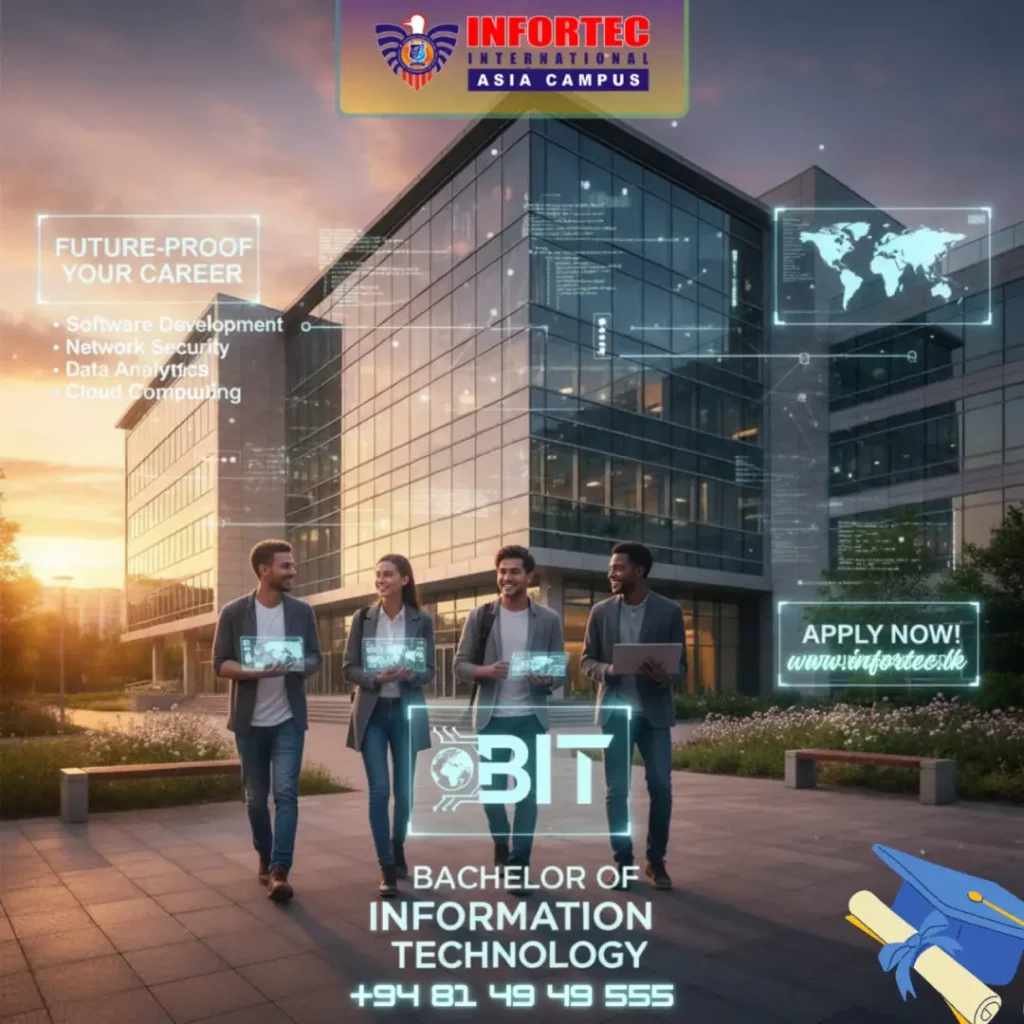
The Programme meets all requirements to consider it as a Bachelors in Education Programme at Level six, seven as prescribed in Sri Lanka Qualification Framework (SLQF).

Introduction to the Bachelor of Information Technology

The Faculty of Information Technology, Infortec International Asia Campus offers the Bachelor of Information Technology degree program in affiliation with the Lincoln University College. The Faculty of Information Technology, Infortec International Asia Campus offers the Bachelor of Information Technology degree program in affiliation with Lincoln University College. This work-based, self-financing programme is designed to produce professionally qualified nurses who are well equipped to meet the growing demands of healthcare both nationally and internationally.


The Bachelor of Information Technology (BSc IT) programme is designed to develop graduates with strong theoretical knowledge and practical skills in computing and information technology. The programme focuses on core areas such as programming, databases, networking, security, mobile and web technologies, and professional practices in IT.


The curriculum prepares students to analyze problems, design and develop software solutions, manage information systems, and adapt to rapidly evolving technologies. Emphasis is placed on hands-on learning, problem-solving, ethical practice, and industry relevance, enabling graduates to pursue careers in software development, systems administration, networking, cybersecurity, and related IT fields, as well as further academic studies.


Objectives of the Bachelors of Information Technology

  Develop diploma holders and practicing nurses into competent graduates.

  1. Equip graduates with professional and clinical skills required for  Information Technology practice and education.

Duration of the Programme

The minimum period of the programme shall be of 14 months in the work based programme conducted on weekends and after working hours on weekdays (after 6pm). Where any unforeseen circumstances arise, the Faculty Board of the Faculty of Information Technology with the approval of the Senate of the Infortec International Asia Campus has the right to extend the duration of the programme. In the event, the student shall maintain the registration valid so as to cover such extended period of time.


No student shall keep away from classes or leave the Island or withdraw from the examinations or a classroom test or other forms of evaluation/assessments without prior approval from the Faculty Board. Such requests should be submitted for approval to the Faculty Board through the Coordinator of the Programme.

Programme Details

The programme is comprised of 15 course units of 51 total credits (total 120 after credit transfer) offered in 4 semesters as prescribed in the schedule. The Course Work includes compulsory and optional course units.

Admission Requirements:

  Diploma in  Information Technology or equivalent recognized by UGC / TVEC

  NVQ Level 4 (or equivalent) with relevant work experience

Application Procedure

Any person who has fulfilled the above admission requirements may submit a duly completed application on a prescribed form provided by the faculty when the programme is advertised in the printed / Electronic Media / social media and the Campus website. Completed applications should accompany proof for the prescribed processing fee and copies of other required documents such as birth certificate, educational / professional certificates and other relevant documents in the required document list.


  1. Processing of Applications

Applications are initially screened by the Coordinator and/or a Board appointed by the Faculty Board. The decision of the Faculty of Information Technology will be final with regard to the admission for the BA (Hons) in  Information Technology

Registration and Fees

The selected applicants should submit certified copies of the relevant certificates before admission to the programme. The date of registration is decided by the Faculty of Information Technology. Registration is valid only for 2 academic years.

The fees may be revised each academic year according to the expenditure at that time. 


Continuation of Registration

If any student is unable to complete the Programme within the relevant academic year, it is the responsibility of the student to maintain the continuity of registration by paying the prescribed fee for the renewal of registration.


  • Cancellation of Registration

Faculty Board of the Faculty of Information Technology reserves the right to recommend the cancellation of the registration of a student due to the following reasons;

  1. Poor attendance (below 50% of attendance)
  2. Violation of the Rules and Regulations of the Faculty of Information Technology mentioned in the Section 3.0 of this Book.
  3. Failure to pay the prescribed Fees
  4. Any other reasons as decided by the Faculty Board


Leave of Absence

Leave of absence to a student for the Programme is granted only on the Medical grounds or any other valid reason acceptable to the Faculty Board. Request for such leave should be made in writing to the Chairman of the Faculty Board through the programme coordinator (Ref. Rules and Regulations in the Section 3.0).

Details of Bachelors of Information Technology

  • Programme Learning Outcomes (Graduate Profile)

Upon completion of the BA (Hons) in  Information Technology program at the Faculty of Information Technology, student teachers will be able to;


Knowledge and Understanding 

  1. Demonstrate a high level of professional knowledge and pedagogical competence, with depth in the underlying principles and concepts in one or more professional courses as a basis for designing, managing and critically evaluating underlying theories and concepts of learning and whole person development to cater for a wide variety of learning situations in fostering student-centered interactive and self-directed learning.
  2. Demonstrate a critical understanding of contemporary issues in local and global professional education contexts pertinent to current practical knowledge, policies and practices and their impacts on teaching and learning as well as on schools and educational institutions.


SKILLS

  1. Demonstrate the application of professional knowledge and skills with initiative and judgment in planning, problem solving and decision making in professional practice with the efficient use of modern educational technologies in complex teaching activities.
  2. Perform effectively as an individual and as a member or leader by maintaining a collaborative partnership with diverse teams including colleagues, parents, authorities and the community in facing the challenges of the new millennium.
  3. Use written and oral communication effectively with teaching community and the wider society including engaging with people of diverse cultures with inter- cultural sensitivity and interpersonal skills to promote the enhancement of teaching and learning and respond to changes in education.
  4. Demonstrate capacity to perform as better managers in implementing the expected curriculum at schools and educational institutions.
  5. Conduct investigations to analyze complex educational problems in a methodical way including literature surveys, design and conduct of experiments, analysis and interpretation of experimental data, and synthesis of information to derive valid conclusions.


ATTITUDES

  1. Demonstrate the commitment for professional ethics and responsibilities and norms of teaching practice, show sensitivity and respect for diverse interests and backgrounds of stakeholders of the education communities and advocate and strive for equity and social justice for all learners.


  • MINDSET
  1. Critically analyze and reflect on their teaching experience and practices to articulate and evaluate their own theoretical perspective on teaching and learning enabling to recognize the need for and work continuously towards their own professional development.

Course Modules

No: MQA Subject Code Course Title Credits
1
BIT 113
Business English
3
2
BIT 131
Computer Programming
3
5
BIT 246
Logic Design
3
6
BIT 251
Java Programming
3

Total Credits

12

No: MQA Subject Code Course Title Credits
7
BIT 252
Server-Side Programming
4
9
BIT 371
RDBMS with SQL / Oracle
3
3
BIT 241
Human Computer Interaction (HCI)
3
8
BIT 253
Social and Professional Issues in Computing
3

Total Credits

13

No: MQA Subject Code Course Title Credits
4
BIT 244
TCP/IP
4
10
BIT 372
Mobile Computing
3
14
BIT 383
Cryptography & Network Security
3
15
BIT 391
Final Research Project
6

Total Credits

16